
If you run conferences or professional development programs on Sched, the event scheduling platform, and want to know what each alternative would cost before you sit through a sales call, this comparison is for you. Every price below comes from the vendor’s own published pages, pulled in 2026, and where a vendor publishes nothing, we say so rather than estimate.
The short list
- Conference Tracker for conferences that certify attendance: CEU, CME, and professional development events, from $990 per event with no subscription.
- Expo Pass for badge-first onsite operations from $2,495.
- EventMobi for association events priced per attendee from $3,000.
- Whova for engagement-first agendas, at quote-only pricing.
- Accelevents for annual event portfolios from $7,500.
How we compared
We compared published pricing, which features each platform bundles at which tier, and the attendance and certification layer in particular, because Sched’s own audience of school PD days, higher education, and CME events is exactly the buyer who eventually has to prove who attended. Conference Tracker is our product, so we held ourselves to the fairest method we know: every vendor’s own published numbers side by side, each one sourced, with a clear section on who should stay put. Nothing here comes from review sites.
Published pricing at a glance
| Platform | Best for | Published pricing | Pricing model |
|---|---|---|---|
| Sched | agendas and simple registration | from $200 per event; attendance tier from $1,500 per event | per event or annual, scales by attendee count, ticketing fees |
| Conference Tracker | attendance and credit certification | from $990 (300-attendee event) | flat per event, no subscription, no per-attendee fees |
| Expo Pass | badge printing and check-in | from $2,495 | quote built per event above the floor |
| EventMobi | association conferences | from $3,000 per event, $8,900 per year | per attendee, add-ons priced separately |
| Whova | attendee engagement | not published | quote request form |
| Accelevents | registration-centric portfolios | plans at $7,500 and $13,500 | annual, virtual as paid add-on |
What organizers outgrow on Sched
Sched’s published tiers tell the story on their own. The agenda, registration, and app basics start at $200 per event, but the layer a certifying event needs, meaning attendance tracking and check-in, customizable badges, lead retrieval, and the advanced call for papers, arrives in the tier priced from $1,500 per event. On top of that, pricing scales with attendee count and ticketing fees apply, advertised as 50 percent lower only on the top tier.
None of that is a defect. Sched is a platform built agenda-first and priced accordingly, which simply means that the moment your event has to track and prove attendance, you are no longer buying the $200 product. The comparison below starts at that moment.
Conference Tracker
Check people in fast. Prove they were there.
Conference Tracker scans attendees with the phones your staff already carry, tracks time in every session, and issues certificates and CEU transcripts on its own. One conference ran 2,623 attendees across 186 sessions on it.
30+ years building attendance tracking for events and education

Conference Tracker: the attendance and credit engine, from $990 per event
Conference Tracker is built in the opposite order, with attendance and certification first and the agenda and registration arranged around them. Pricing starts at $990 for a 300-attendee event, flat per event with nothing metered per attendee and no annual subscription, which makes it the only platform on this page with a published starting price under four figures and nothing recurring to justify next year.
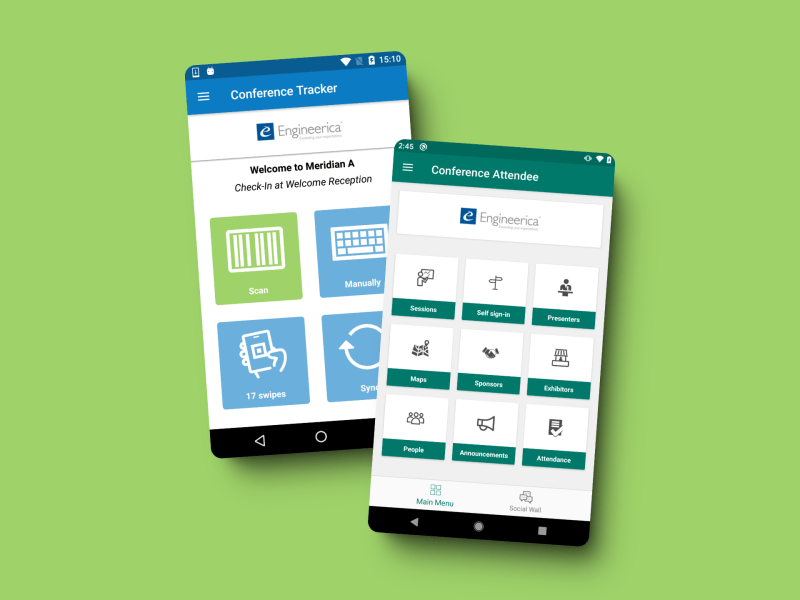
The certification machinery is the part no competitor page states, so it is worth spelling out. Each session carries its own presence rule, a minimum percentage or number of minutes, and can require sign-out where staying matters rather than just arriving. Credit can then be held back until the attendee passes a quiz that only unlocks after attending, at a pass score you set, or until they complete the session evaluation.
Virtual viewers are tracked automatically and prompted with a still-watching check that removes idle screens, so a tab left open does not earn a credit. Every credit then traces back through five-status attendance logs to the individual swipe and the device that captured it, which is the evidence trail an accreditor audit actually asks for. When the conference ends, attendees download their own Certificates of Attendance and per-session CEU transcripts, and nobody on your staff mail-merges anything.
The rest of the conference runs in the same system. The call for papers supports open, single-blind, or double-blind review with a rebuttal phase, registration payments land directly in your own PayPal, Stripe, or Authorize.net account, and the Conference Attendee app carries schedules, messaging, and the event feed.
Operationally it travels light. Staff scan on their own phones with a free app, the scans keep capturing offline and sync when the venue wifi returns, and badges print on ordinary office printers and Avery stock. At scale that looks like the Texas Emergency Management Conference, which ran 2,623 attendees across 186 sessions on 22 leased scanning devices and went from purchase order to a running conference in 12 days.
If your events end with credits to prove, request a Conference Tracker demo and price your next conference in one call.
Two honest limits apply. Virtual and mixed sessions are a paid add-on called the Virtual Package, and there is no venue sourcing or corporate travel layer, so an event that is really a webinar series, or a team that is buying travel management, is shopping in a different category.
Expo Pass: badge-first onsite from $2,495
Expo Pass publishes a starting price of $2,495 and leads with the onsite stack of registration, badge printing and check-in, lead capture, and attendance tracking, with CE tracking and certificates advertised as well. The number above that floor comes from a quote shaped by attendee count and product mix. What its pages do not state are the enforcement mechanics, such as minimum-presence rules, required sign-out, or quiz-gated credit.
EventMobi: association events priced per attendee
EventMobi publishes two models, per event from $3,000 or per year from $8,900, with per-attendee pricing its own page puts as low as $1 to $3. Its check-in app records session in and out with the duration visible, and CE verification is stated. Because the extras are itemized separately, badge stock, lead capture per exhibitor, and integrations among them, a full deployment should be priced as a total rather than from the headline.
Whova: engagement-first at quote-only pricing
Whova reports over 50,000 events across 170+ countries on its own site, and its core pitch is the attendee app and the engagement features around it. Badges print on popular printers, check-in runs by QR at event, day, and session level, and certificates generate from attendance records. It publishes no pricing, though, and its pricing page is a quote request form, which matters when procurement needs a number before a conversation.
Accelevents: annual portfolios from $7,500
Accelevents publishes annual plans at $7,500 and $13,500 with unlimited events and admin seats, aimed at teams running a calendar of events rather than one. Check-in works offline and syncs when the connection returns, and CE credits are mentioned for session tracking. Virtual events are a paid add-on, and for a single yearly conference the annual commitment itself is the thing to weigh.
Where Sched stays the right call
Keep Sched when its entry tiers already cover the whole job. Events under 50 attendees ride its free tier, and a PD day or community event that needs an agenda, registration, and a polished schedule page, with SOC 2 Type II and FERPA compliance stated on its site, is well served without the attendance layer. Switching earns its cost at the moment attendance has to be proven, credited, and defended.
Which alternative fits which event
Choose by what your event has to prove. If it certifies attendance on a fixed budget, Conference Tracker does that from $990 flat with the audit trail built in. If it is a badge-heavy expo, Expo Pass is built around that floor, and an association running a calendar of events is better served by EventMobi per attendee or Accelevents annually than by any single-event price. Whova fits an engagement-first program with the budget room to wait for a quote.
We keep the same published-pricing comparison for the Cvent field, for the Bizzabo field, and for virtual-first platforms, and every number on this page is the vendor’s own, current as of 2026.