Most registration platforms are easy to like on the day you sign up. The form builder is free, the page looks good, and the first registrations arrive within hours. The trouble shows up later, when the fee statement for a 300-person conference comes in and the per-ticket charges that sounded trivial in the sales copy have quietly taken a few thousand dollars out of the budget.
That is why comparing registration platforms on features alone misleads. The form is the easy part, and every tool on this list builds a good one. What separates them is everything that happens after someone clicks submit: who pays the fees and how fast they grow with attendance, whether the registration becomes a badge and a check-in record without a second system, and whether you can buy the platform for one event instead of a year.
So this comparison prices six platforms on their own published numbers, current as of 2026, and then works the fees out for one realistic conference. Dollars compare more honestly than adjectives.
The short list
- Conference Tracker if registration has to feed check-in, badges, and continuing education credits, from $990 per event.
- Eventbrite for public ticketed events, with no fees on free events and per-ticket fees on paid ones.
- RegFox for complex registration forms on a capped per-registrant fee, with no monthly charge on its first two plans.
- Whova for conferences that choose the attendee app first and take registration along with it, priced by quote.
- Bizzabo for enterprise event programs on an annual contract, from $17,999 per year.
- Accelevents for a full calendar of mixed events on one plan, from $7,500 per year.
How we compared
We read each vendor’s own pricing page and compared four things: the published price, who pays the fees and how they scale with attendance, whether a registration flows into check-in and credit records without a second system, and whether the platform can be bought for a single event. Conference Tracker is our product, so we kept the method strict: vendor-published numbers only, retrieval dates recorded in our fact-check file, no third-party review scores, and a section further down on when a per-ticket platform is genuinely the better buy.
One question comes up often enough to answer here: why not just use a form builder? A general-purpose form will collect names, and for a free lunch-and-learn that may be all you need. For anything with a fee, a badge, or a session to check people into, it stops exactly where the work begins, which is the gap a registration platform exists to fill.
Published pricing at a glance
| Platform | Best for | Published pricing | Pricing model |
|---|---|---|---|
| Conference Tracker | conferences that certify attendance | from $990 (300-attendee event) | flat per event, no subscription, no per-attendee fees; card processing on your own PayPal, Stripe, or Authorize.net account |
| Eventbrite | public ticketed events | 3.7% + $1.79 service fee per paid ticket, plus 2.9% payment processing per order; free events carry no fees | per-ticket fees, paid by buyers by default or absorbed by the organizer |
| RegFox | form-heavy registration programs | $0.99 + 1% per registration, capped at $4.99 (Standard); $1.99 + 1%, capped at $5.99 (Premium); Professional $499 per month billed annually | per-registration fees, $0 monthly on Standard and Premium; card processing 2.9% + 30¢ on all plans |
| Whova | app-first conferences | not published | quote request only |
| Bizzabo | enterprise event programs | $17,999 per year ($499 per user per month, 3-user minimum) | annual subscription required, no single-event purchase |
| Accelevents | annual mixed-event portfolios | plans at $7,500 and $13,500 per year | annual, unlimited events, unlimited ticket types, virtual as a paid add-on |
How much does event registration software cost on one real conference?
Take a conference with 300 paid registrations at $250 each, so $75,000 collected. We picked 300 attendees because that is the event size Conference Tracker publishes its sample price for, which lets every platform below be priced on the same conference.
On Eventbrite, the service fee works out to 3.7 percent of $250 plus $1.79, or $11.04 per ticket, which comes to $3,312 across 300 tickets. Payment processing then adds 2.9 percent of each order, roughly $2,175 on $75,000. All in, about $5,487 leaves the event in fees. Attendees pay those fees by default and the organizer can choose to absorb them instead, but either way none of that money buys check-in or credit tracking.
RegFox’s Standard plan charges $0.99 plus 1 percent of the ticket price per registrant, so $3.49 each, or $1,047 for the conference. Card processing through its own Webconnex Payments adds 2.9 percent plus 30 cents per transaction, about $2,265 more, for a total near $3,312. RegFox notes that the registration fee can be passed on to attendees.
Conference Tracker publishes $990 as its sample price for a 300-attendee event, and that price is flat. Card processing happens on your own Stripe, Authorize.net, or PayPal account at whatever that gateway charges you, so the platform itself takes nothing per attendee, and registration number 301 does not change the bill.
The two annual platforms sit in a different budget altogether. Bizzabo costs $17,999 for the year whatever the attendance, and Accelevents $7,500 for the year; both earn their price when the year holds many events, and neither is really priced for one conference. Whova does not publish a price, so it quotes.
Conference Tracker
Check people in fast. Prove they were there.
Conference Tracker scans attendees with the phones your staff already carry, tracks time in every session, and issues certificates and CEU transcripts on its own. One conference ran 2,623 attendees across 186 sessions on it.
30+ years building attendance tracking for events and education

Conference Tracker: registration that feeds check-in, badges, and credits, from $990 per event
Conference Tracker prices the event rather than the attendee. The published sample for a 300-attendee conference is $990, flat, with no subscription behind it and no per-attendee fees on top. The plan and attendee limit are bought through a checkout inside the account, so a single conference does not have to go through a procurement cycle to get started.
Its registration forms are built for organizers who want to stay in control of who gets in. Attendees and exhibitors fill in separate forms that you customize, and every registration that arrives can be reviewed, edited, confirmed, canceled, or deleted rather than accepted automatically. Any form field can carry its own price, so a workshop seat or a conference dinner sells on the same form as the ticket, and fields can be grouped so that a question appears only when a registrant picks the option it applies to.
The pricing tools cover a normal campaign without workarounds. An early-bird fee replaces the base fee until a cutoff date you set. Coupons can take a flat amount off, a percentage off, or substitute a fixed price, each with an expiration date and a cap on how many times it can be used, and a coupon issued to a named list of email addresses applies itself when those people register. If a company wants to send its whole team, one form registers all of them at once.
Sessions are handled at the same moment. Attendees choose their sessions while they register, each session can carry its own fee and a capacity that closes it once it fills, and the system can refuse a second booking that overlaps the first, which spares you the usual week of untangling schedules by email.
Where Conference Tracker differs most from the per-ticket platforms is the money itself. The form accepts PayPal, card payments through Stripe or Authorize.net, and bank account payments through Authorize.net, all running on the organizer’s own gateway credentials, so registration revenue lands in your account rather than in the platform’s.
From there the record keeps itself honest. Every registration carries one of five statuses from pending to accepted, and you decide whether registrations are vetted by hand or accepted automatically. Anyone who cannot pay online can be invoiced instead, and chasing everyone who still owes money is a single action rather than a mail merge.
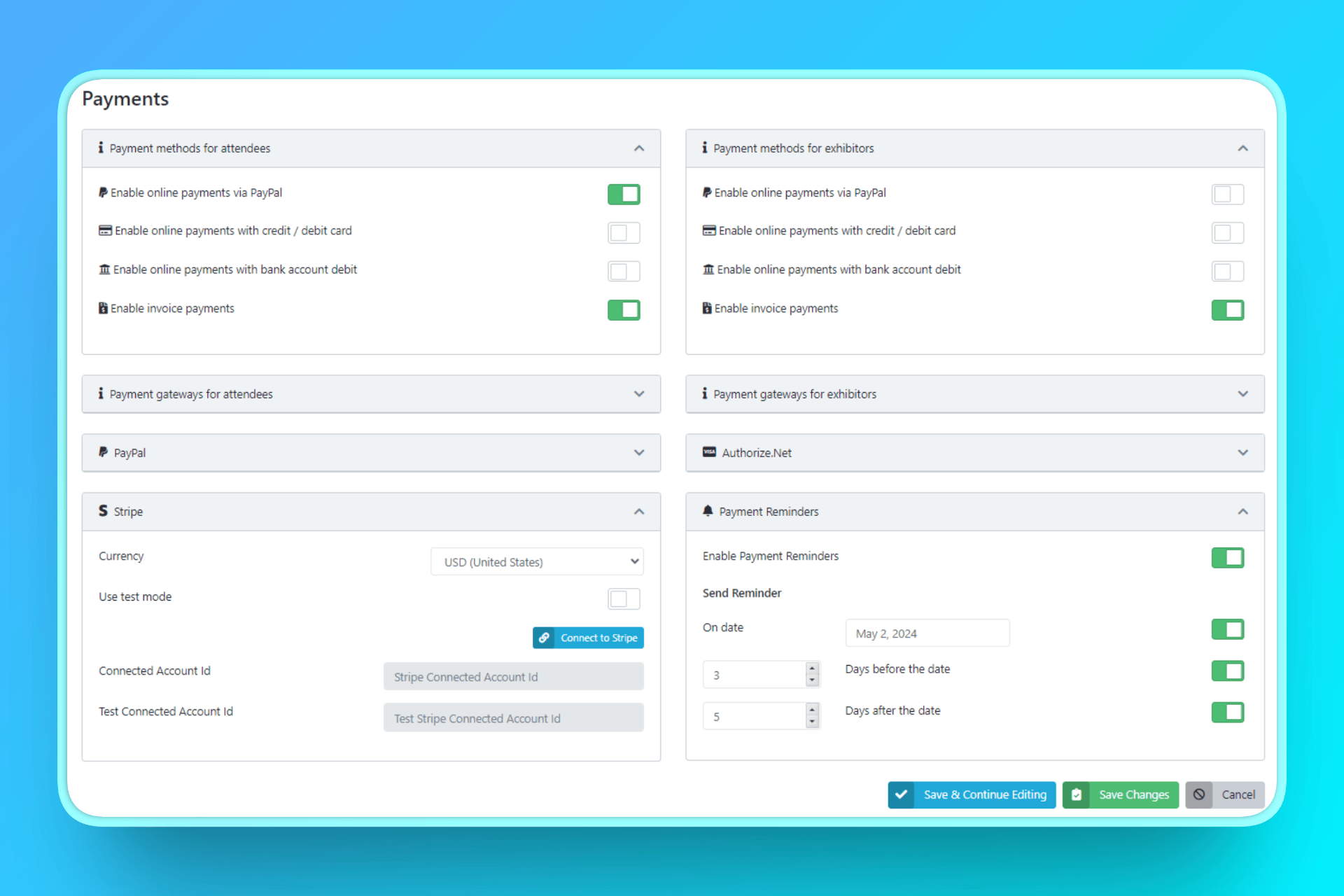
The reason conferences buy it, though, is what the registration turns into afterwards. Each registration becomes a badge in a design you created, printed on standard badge stock through an ordinary office printer or a thermal label printer, or emailed to the attendee before they travel, and at the desk, checking someone in and printing their badge is one action. Someone who never registered can be registered, charged, and admitted at a walk-in kiosk. Because the same record follows the attendee into the sessions, their attendance, the credits calculated from it, and their own certificate and CEU transcript are all available to them from the conference home page without anyone on your staff producing them.
Around that core sit the pieces you would otherwise bolt on. The event gets a public website with the registration form attached. The Registration Financial Report breaks revenue down by payment method and shows cancellations and discounts given, and every record exports as CSV, HTML, or Excel under a stated policy that the data belongs to you. The whole registration module is documented end to end on our conference registration software page.

It has been proven at scale, too. The Texas Emergency Management Conference ran 2,623 attendees across 186 sessions on Conference Tracker, and that deployment went from purchase order to a running conference in 12 days.
If your registrations need to become badges, check-ins, and credits without a second system, request a Conference Tracker demo and price your conference as a single event.
Two limits are worth knowing before you compare further. Conference Tracker does not process refunds inside the product, so a refund is issued at your payment gateway and then recorded by marking the transaction refunded, and online or mixed sessions require the separately purchased Virtual Package. If what you are really running is a one-night public show with tickets sold to strangers, a per-ticket platform is the more natural fit, and the next two entries explain why.
Eventbrite: no fees on free events, per-ticket fees on paid ones
Eventbrite publishes the simplest pricing model on this list. Free events carry no fees at all. Paid tickets carry a service fee of 3.7 percent plus $1.79 per ticket and a payment processing fee of 2.9 percent per order, and those fees are paid by the ticket buyer by default, with an option for the organizer to absorb them when setting up ticket types.
That model suits events that sell tickets to the public, where being discoverable matters and the organizer wants no fixed cost up front. Eventbrite Pro, its paid marketing add-on for sending up to 10,000 emails a day, starts at $15 per month. What the platform is not built around is session-level attendance and credit records, so a conference that must certify who attended which session usually ends up pairing it with a second tool.
RegFox: per-registrant fees with a cap, no monthly charge to start
RegFox, made by Webconnex, publishes three plans. Standard and Premium both cost $0 per month and charge per registration instead: $0.99 plus 1 percent capped at $4.99 on Standard, or $1.99 plus 1 percent capped at $5.99 on Premium. The Professional plan costs $499 per month billed annually and keeps the Premium per-registration fee. Free events are charged $0.99 or $1.99 per registrant depending on the plan, and card processing is 2.9 percent plus 30 cents per transaction on every plan through Webconnex Payments.
The cap is the detail that matters most once tickets get expensive, because on a $500 registration the Standard fee still stops at $4.99. RegFox fits organizations that run a few form-heavy registration programs a year and want conditional logic without paying a platform fee for it. Badge printing and a check-in app are listed among its features, but credit tracking is not what the product is built around.
Whova: the attendee app first, registration priced by quote
Whova does not publish pricing; its pricing page takes a quote request instead. The product is centered on its attendee app, with registration and ticketing offered alongside it, and while session check-in appears on its pages, the depth of sign-in and sign-out tracking is not spelled out.
It fits conferences that are buying the engagement layer first and are happy for registration to ride along, with a budget that can wait for the quote.
Bizzabo: enterprise programs on an annual contract
Bizzabo publishes $17,999 per year, which is $499 per user per month with a three-user minimum, and its own FAQ states that an annual subscription is required and no single-event purchase is offered. Registrations are unlimited within the plan, while a custom-branded app and virtual events are quoted as add-ons.
That suits a corporate events team running a program all year rather than a single conference. If the comparison you are actually making is against that enterprise tier, our Cvent alternatives comparison prices that end of the market in the same published-pricing format as this one.
Accelevents: a year of events on one plan
Accelevents publishes plans at $7,500 and $13,500 per year, each with unlimited events, unlimited ticket types, and unlimited admin seats, and sells virtual events as a paid add-on. Its check-in app saves locally and syncs when the connection comes back, a practical detail for venues with poor wifi.
It fits an organization with a full calendar of mixed events that wants registration and ticketing on one annual plan, and it is priced for teams that will actually fill that year.
Where a per-ticket platform stays the right call
Not every event needs a registration record that survives an audit. If you are selling tickets to a public audience of strangers, Eventbrite’s model is hard to argue with: there is no fixed cost, free events cost nothing, and the marketplace does some of your marketing for you. If your real job is a sophisticated registration form for a program that runs a few times a year, RegFox’s capped per-registrant fee will usually come in below any platform price.
Switching pays off when the registration is the start of a record rather than the end of a sale. That means sessions with capacities and fees, badges printed at the desk, attendance that has to stand up to an accreditation review, and a budget that belongs to one conference rather than to a year of them.
Which platform fits which event
The simplest way to choose is to ask what the registration has to do after the form is submitted. If it has to turn into badges, check-ins, and credits from a single record, Conference Tracker does that for $990 per event. If it only has to sell tickets to the public with no fixed cost, Eventbrite is built for exactly that, and if the hard part is a complex form rather than what comes after it, RegFox’s capped fee is the economical answer.
The remaining three are decided by how you buy. Whova makes sense when the attendee app comes first, Bizzabo when an enterprise program justifies an annual contract, and Accelevents when a year of mixed events can share one plan.
If your event is closer to a guest list than a conference, with invitations to confirm rather than sessions to fill, our RSVPify alternatives comparison covers that side of registration. Every number above is the vendor’s own, current as of 2026.