
By week twelve, the F is official. The student stopped attending in week four, stopped submitting in week six, and visited the tutoring center once all term, and every one of those facts was sitting in a campus system while there was still time to act. Identifying at-risk students is a data problem before it is a counseling problem.
If you coordinate student success, advise, or run a learning center, the question is rarely whether the warning signs existed. It is why nobody saw them together, and what it takes to be the campus where somebody does.
What makes a student at-risk
An at-risk student is a student whose circumstances or current behavior predict course failure or withdrawal unless someone intervenes. The risk comes in two forms. Some students arrive with it: first-generation status without a support network, financial strain, work schedules that collide with class blocks, academic probation carried over from a prior term. Others develop it mid-semester, and that form announces itself in behavior: attendance slipping, submissions stopping, support services never visited.
The label attaches to a situation, and it should stay there: “a student in an at-risk situation” says what changed and invites a response, while “an at-risk student” reads like an identity. Whatever vocabulary your campus settles on, the definition has to stay operational: observable, current, and tied to a response. A risk category nobody can act on is a filing system.
The early warning signs, in the order they appear
Attendance moves first, then work completion, then grades, and the order matters because a grade is a lagging indicator. By the time the transcript says at-risk, the semester is mostly spent.
The academic signals, roughly in sequence: absences begin to cluster instead of scattering. Assignments arrive late, then stop arriving. Participation fades. And the student failing a course has often never signed in at the tutoring center, which makes absence from support services a warning sign in its own right, and one of the earliest measurable ones on any campus that tracks center visits.
The non-academic signals rarely reach an academic system at all: a financial hold, a family emergency, hours added at an off-campus job. Those arrive through people, a professor or a front-desk staff member who noticed something, which is why a referral route carries weight no dashboard can. Disengagement also has a preventive side; the tactics in our guide to keeping students engaged before they drift work on the same early timeline.
Why campuses identify at-risk students late
The signals exist on nearly every campus. They sit in systems nobody joins: the LMS holds submissions, the SIS holds enrollment and holds, gradebooks hold the midterm warning, and the center’s sign-in records hold help-seeking. No single system looks alarming on its own, and nobody is paid to read all four.
The second failure is reporting friction. A faculty member with a worried feeling about a student will not fight a clumsy process to report it. Southern University at Shreveport’s Center for Student Success lived this: its homegrown early alert system proved too hard for faculty to use, and the concerns stayed in inboxes and hallways. Calumet College of St. Joseph ran academic alerts through a form on its website, which reached one office at a time and kept no history of what happened after submission.
The third failure is silence. A professor who reports a student and hears nothing back concludes the report went nowhere, and stops writing them. Referral volume then drops, the office reads the quiet as fewer struggling students, and the gap between the two becomes the retention number.
Accudemia
Your center helps more students than you can prove
Accudemia records every visit, appointment, and session on its own, then builds the reports deans, funders, and accreditors ask for. One college counted over 4,000 visits its previous tools had missed.
96 percent renewal across 500+ academic centers

What is an early alert system?
An early alert system is the campus workflow that turns a warning sign into an owned intervention: it captures the signal, routes it to a named person, records the contact with the student, and closes only when the situation is resolved or deliberately handed off. The name is shared with campus emergency notification tools, which are a different product entirely; an early alert here is academic, about one student, weeks before a deadline rather than minutes after an incident.
Capture works two ways, and a serious system runs both. Rules watch the data for patterns: absence counts, attendance percentages, missed submissions. People watch the student: a referral from someone who noticed what no threshold can see. Routing gives each alert an owner, the record keeps every contact and comment, closure forces an outcome, and measurement tells you next semester whether any of it worked.
The referral loop that faculty actually use
Faculty raise referrals when submitting one takes less effort than worrying, and when the referrer hears back. Every working early alert loop has both properties.
Southern University at Shreveport chose Accudemia primarily for its referral feature after the homegrown attempt failed. A referral on an at-risk student is assigned to a Success Coach who contacts the student, and the referring faculty member is alerted at every contact, update, and agreed action until the referral closes with the student back on track. The loop is the point: faculty keep reporting because the system keeps answering.
Kishwaukee College routes concerns from any staff member through advisors into referrals, then tracks whether the referred student actually shows up and notifies the referrer either way. Calumet College of St. Joseph, after retiring its web form, got several departments informed by one alert, automatic notification to the student, and a record that updates with every change.
The mechanics behind those loops are worth copying whatever platform runs them. Referral templates fix in advance what information the center needs, with required questions, so no alert arrives unusable. Submission emails a designated follow-up owner and copies the listed staff rather than one inbox. And every edit and follow-up comment lands in a permanent referral history, so the case survives handoffs between people. Shreveport’s team has published a fuller account of rebuilding the alert process around its success coaches, from intake to the faculty loop.
Attendance data is the earliest alert you already collect
Class attendance and support-center sign-ins are the earliest leading indicator you already collect, and the one least often wired into an alert process. Davis & Elkins College is the clean demonstration: once it moved center tracking off paper and spreadsheets, it recorded over 4,000 more visits than the prior year’s tools had captured and discovered it was assisting 61 percent of the student population. The visits were always happening. The tooling decided whether anyone could see them, and stakeholders there now receive recurring reports on at-risk students automatically.
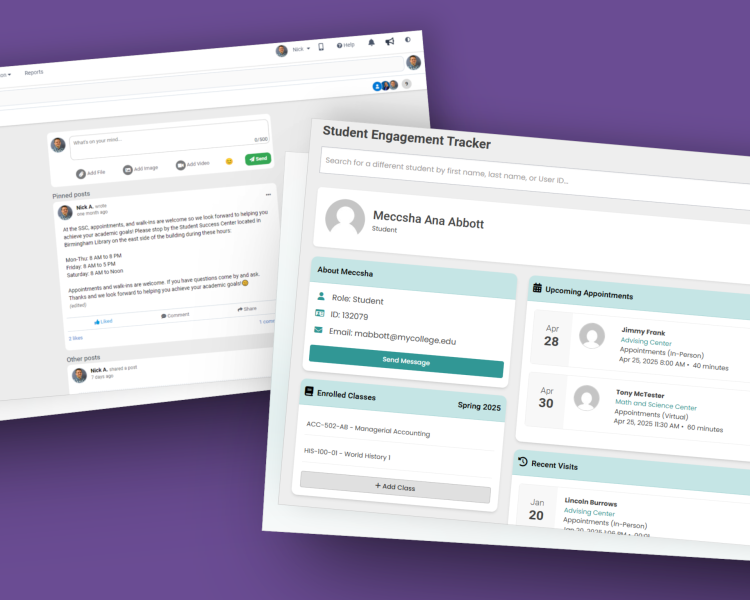
Wiring attendance into alerts works at three layers. In the classroom, AccuClass includes a Retention Center that flags students by rule, on absence counts, consecutive absences, or an attendance percentage, scoped to populations such as student athletes, and notifies the student, the instructor, and a named third recipient, with a weekly summary to administrators. Campus-wide, AccuCampus scores each student’s dropout risk weekly from the institution’s own accumulated data, and its documentation is plain that a score is a signal for a human to act on rather than a verdict about the student. And in the center itself, Accudemia ties sign-in stations, per-session assessments, and the referral loop into one record, which is how Shreveport tracks whether its at-risk students follow through, in person and virtually.
If your center already collects sign-ins and your early alerts still run on email and memory, request an Accudemia demo and see the referral loop running on your own intake, coaches, and reports.
Prove the intervention worked
The measure of an early alert program is follow-through, not referral volume: whether flagged students showed up for help, and whether they stayed enrolled. Referral counts only prove that faculty are worried. Shreveport pulls follow-through reporting on its referred students for exactly this reason, and Santa Barbara City College’s Institutional Research office uses its center data to show the effect on retention and success semester after semester.
The stakes are budgetary. The Community College of Denver’s EXCEL! Zone built its session assessment questionnaire together with Institutional Research so the qualitative data tutors record maps directly to what the state requires for funding, and that data saved the center from being shut down in 2020. Budget committees rarely ask whether a center helped students. They ask for the number that shows it.
Early alerts are the front half of a retention system; what happens after the student walks through the door decides the back half. The playbook for that half, from first outreach to semester-end measurement, is in our student retention guide for center directors.
Start with the data you have
List the signals your campus already captures this week: class attendance, center sign-ins, LMS submissions, holds. Pick one referral route, publish it to faculty, and give every alert a named owner from day one. Measure follow-through from the first week, because that number is simultaneously the intervention working and the budget case for it. One semester of a small loop that closes will beat another year of a committee that meets.


